
Your needs, this model
Does it fit your priorities?
Does the XT505 include hammer-drilling mode for masonry work?
Yes. The XT505 package page names an XPH10Z hammer driver-drill. The XPH10 manual describes separate rotation-only drilling, hammer drilling and clutch-controlled screwdriving modes; it also lists 1/2-in concrete and steel and 1-1/2-in wood capacities. Use its specified bit and safety instructions, and do not treat those ratings as a promise for every material or hole.
Explore this need in the finder →What is actually in the five-piece XT505 kit?
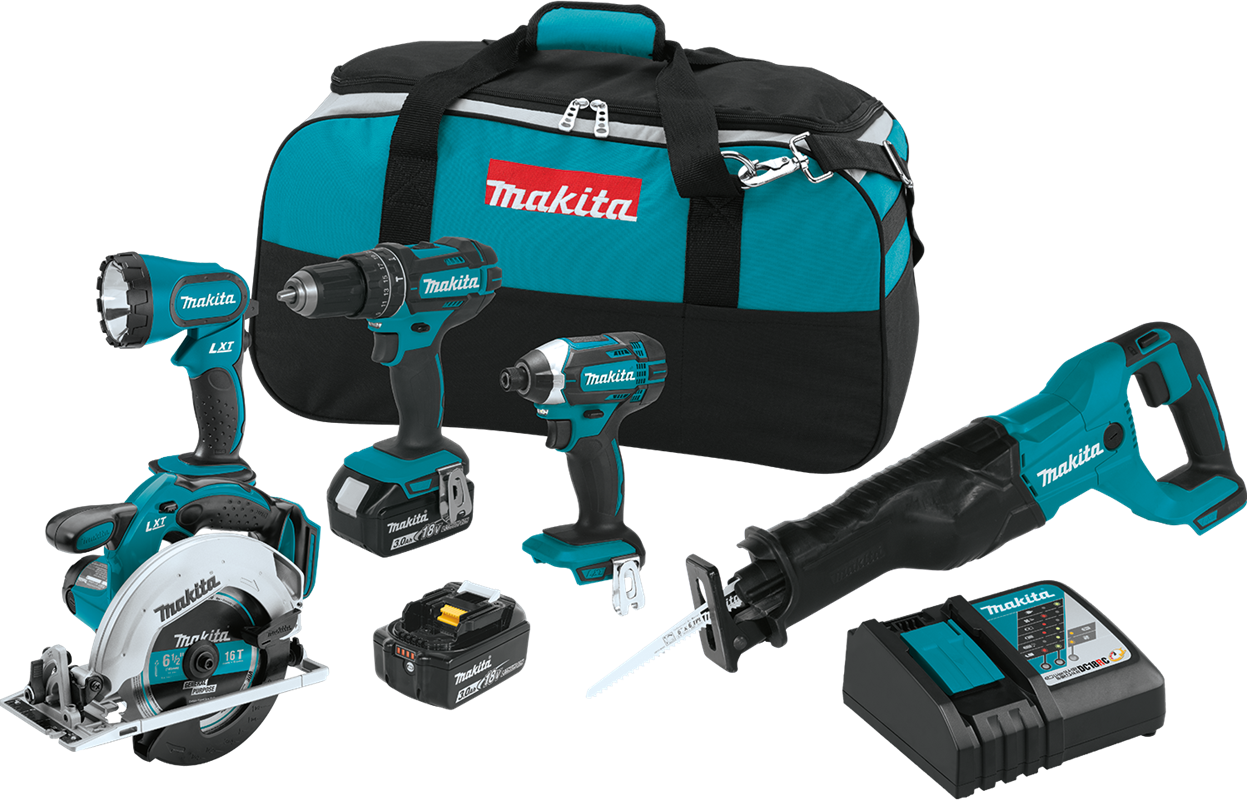
Makita's written list gives one XPH10Z hammer driver-drill, one separate XDT11Z impact driver, one XRJ04Z reciprocating saw, one XSS02Z circular saw, one DML185 flashlight, two BL1830B 3.0Ah batteries, a DC18RC charger and a tool bag. The impact driver is an extra fastening tool, not a second drill or a source of hammer mode.
Explore this need in the finder →Can the XT505's drill head be confirmed at six inches or less?
No. Makita provides a 7-3/4-in overall-length figure for XPH10, but the reviewed sources do not state a separate tool-head length. Overall length does not establish the chuck-to-housing head dimension or clearance for a hand, battery or bit, so this strict short-head requirement is not confirmed.
Explore this need in the finder →The Makita XT505 is not just a drill-and-driver pair: Makita lists five tools in the kit. The drilling tool is the XPH10Z, an 18V LXT brushed 1/2-in hammer driver-drill. The package adds a separate XDT11Z impact driver, an XRJ04Z reciprocating saw, an XSS02Z circular saw and a DML185 flashlight, alongside two BL1830B 3.0Ah batteries, a DC18RC rapid charger and a tool bag. This review assesses the drill arrangement and exact package from manufacturer documentation; it does not report personal use, laboratory measurements or independent performance tests.
The drill's three operating modes
The XPH10 manual describes rotation-only drilling, hammer drilling and screwdriving through a clutch. It also specifies a two-speed transmission: 0–600 rpm in low and 0–1,900 rpm in high, with a stated maximum 9,000/28,500 blows per minute. Makita's XPH10Z page publishes 480 in-lb maximum torque. Those are maker specifications, not comparative test results. The drill is described as brushed, so it should not be mistaken for one of Makita's brushless LXT hammer-drill packages. The manual's 21-step torque adjustment is for screwdriving; hammer drilling is selected separately and uses a different setup.
Makita lists drilling capacities of 1/2 in in steel, 1-1/2 in in wood and 1/2 in in concrete. They describe different materials and uses; none is a universal hole-size promise, and the 1/2-in chuck rating is about the bit shank that fits the jaws. In hammer mode the manual specifically calls for a tungsten-carbide-tipped bit, light pressure and a firm two-handed hold. It warns that a jam, breakthrough or embedded reinforcing bar can create a sudden twisting force. That guidance matters more than reading the headline torque figure as permission to force the tool through a difficult hole.
What the XT505 package adds—and what it does not
The box list makes the XT505 unusual among drill options: four other tools accompany the hammer drill. XDT11Z is a separate impact driver for fastening, not an impact setting on the XPH10Z and not a substitute for its hammer-drilling mode. The reciprocating and circular saws broaden the package only if those are useful tools for the buyer as well. If they would be duplicates or go unused, this five-tool kit may be a poor-value fit even though its drill matches a need.
The exact page names two BL1830B 3.0Ah LXT batteries, a DC18RC Rapid Optimum charger and a tool bag. That is a battery-included package, not the XPH10Z tool-only SKU. The closely related XPH10R one-drill kit instead lists two BL1820B 2.0Ah packs, a DC18RC charger, hook and case; XPH10Z alone is sold without a battery or charger. These package differences—not an assumed change in the drill body—are the useful comparison. The stated amp-hour labels are package facts, not a tested runtime estimate.
Length and weight need careful reading
Makita gives the XPH10 an overall length of 7-3/4 in. It does not provide a separate tool-head measurement in the reviewed sources, so the overall figure cannot verify a six-inch-or-shorter head. Nor does it establish whether the drill, installed battery, hand and bit will clear a tight cabinet or joist bay. For a strict recess limit, get an exact head dimension and check the complete working envelope rather than treating this as a compact drill.
There is also a genuine weight discrepancy. The XPH10Z and XT505 pages state 3.4 lb with battery without identifying the pack in that line. The XPH10 manual lists 3.4 lb for a group including BL1815N, BL1820 and BL1820B, then 3.9 lb for a group including BL1830 and BL1830B—the 3.0Ah battery supplied with XT505. I keep the kit's exact installed-drill weight unresolved instead of selecting the more convenient number. The 32.19-lb shipping figure on the kit page describes the shipped package, not the drill's carry weight.
Who should consider XT505?
Its strongest fit is a buyer deliberately starting or expanding the LXT platform who needs hammer mode, wants a conventional 1/2-in chuck and can use the other four tools. Two included 3.0Ah packs and their charger avoid a tool-only purchase, while the XPH10Z remains a brushed hammer drill with documented ordinary-drilling and clutch-screwdriving modes. The exact package is less compelling for someone who only needs a drill, already owns the saws or light, insists on a brushless tool, or requires a verified short head.
This is not an SDS rotary hammer. Match the XPH10 manual's material and bit guidance to the job; a hammer-driver-drill's listed concrete capacity does not certify it for every masonry task. For repeated large holes, ask whether a dedicated rotary hammer is the more appropriate tool rather than relying on a drill's maximum capacity line.
Purchase checks
Confirm the exact XT505 suffix and read the seller's written inclusions. Look for XPH10Z, XDT11Z, XRJ04Z, XSS02Z, DML185, two BL1830B batteries, DC18RC and the bag; do not let an image alone establish quantities or model suffixes. Check that the battery and charger are the exact versions you want, and read the XPH10 manual for mode selection, compatible packs, bit choice and reaction-force precautions. If you need only this drill, compare XT505 with the exact XPH10R kit or XPH10Z bare tool before accepting four additional machines.
Primary references: Makita XT505 U.S. product page; Makita XPH10Z U.S. product page; XPH10 instruction manual; Makita XPH10R kit comparison; Makita XPH10Z tool-only comparison.
Key specifications
Key details at a glance
| Brushless motor | No |
|---|---|
| Maximum chuck capacity | 0.5 in |
| Maximum no-load speed | 1900 rpm |
| Screwdriving clutch settings | 21 |
| Battery platform | Makita 18V LXT |
| Exact package type | Five tool lxt combo kit two bl1830b 3ah batteries dc18rc charger |
| Included battery model | BL1830B |
| Capacity per included battery | 3 Ah |
| Included charger model | DC18RC |
| Kit bag listed | Yes |
| Hammer-drilling mode | Yes |
| Documented operating modes | drilling / screwdriving / hammer drilling |
| Battery included in this SKU | Yes |
| Charger included in this SKU | Yes |
| Included accessory | one tool bag |
Use the exact model’s instructions for operating limits, supplied equipment and version differences.
Sources for this review
Sources for this assessment

Compare your requirements before choosing
Use the finder to keep the essential job, battery system and exact package separate. The match is a research filter, not proof of fit or a live retailer offer.