
Your needs, this model
Does it fit your priorities?
Does the XFD10Z box include a battery or charger?
No. Makita's exact XFD10Z page calls it tool only and says the battery and charger are not included. The separately sold XFD10SY package adds two compact batteries, a DC18SD charger and a tool bag; confirm a particular pack and charger against the XFD10 manual.
Explore this need in the finder →Does XFD10Z provide hammer-drilling mode?
No hammer mode is documented. The XFD10 is a plain driver-drill whose manual covers rotation drilling and clutch screwdriving; a half-inch chuck does not mean it can hammer drill masonry.
Explore this need in the finder →Does the XFD10Z chuck accept a bit with a 1/2-in shank?
Yes, Makita lists a 13-mm (1/2-in) keyless chuck. This is the maximum bit-shank opening, not the maximum hole diameter; use the manual's separate bit/material capacity information.
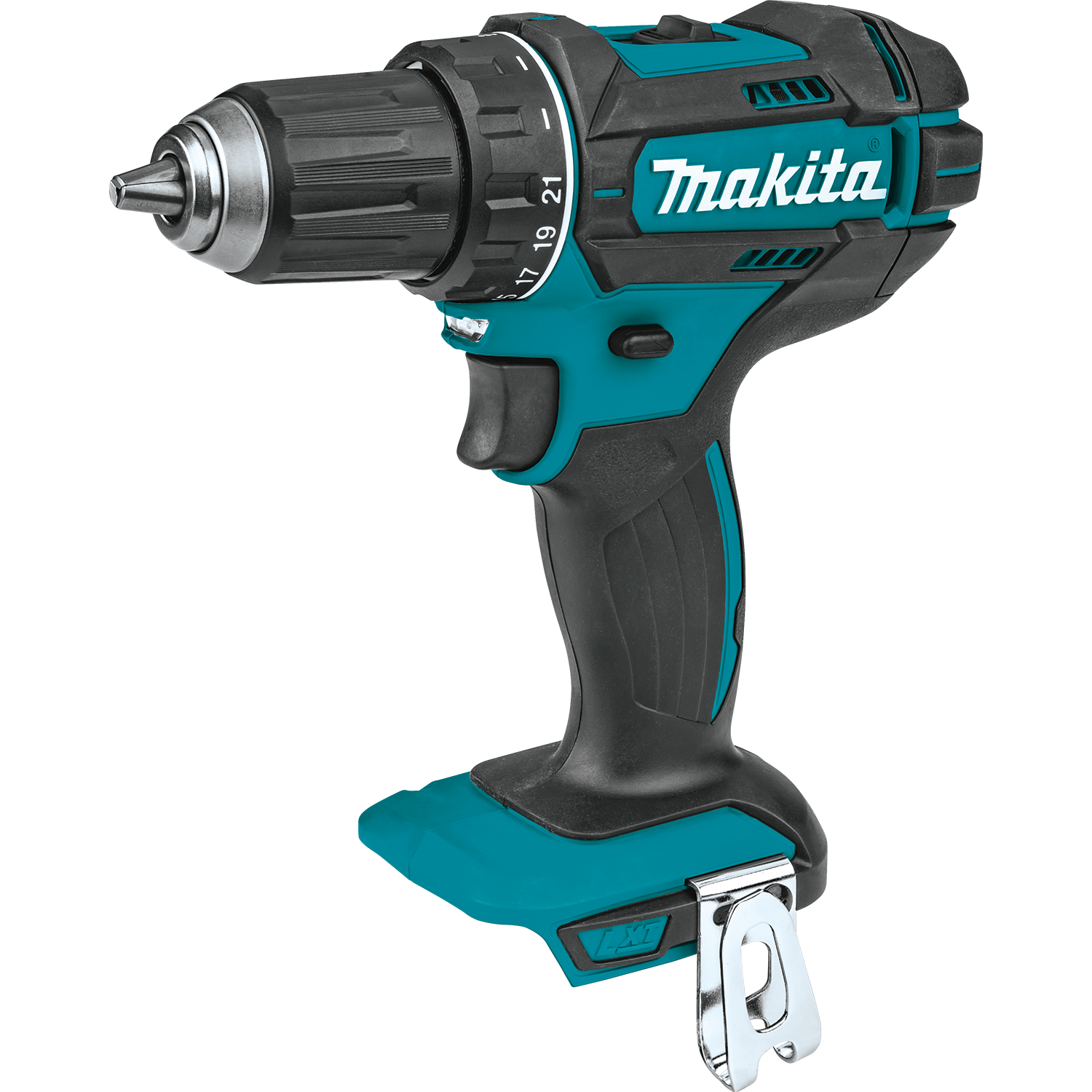
Explore this need in the finder →The XFD10Z is Makita's tool-only version of its compact XFD10 18V LXT driver-drill. The exact U.S. page is unambiguous about the main buying consequence: battery and charger are not included. Makita's separate XFD10SY page names this same XFD10Z drill as the base tool in a kit with two compact batteries, a DC18SD charger and a tool bag. Those kit items belong to the SY package, not the Z suffix. The XFD10Z parts breakdown also flags a hook as standard equipment; that item is supported by the parts record, not by the hook visible in the product photo.
What the bare tool actually offers
The XFD10 is a brushed, two-speed driver-drill with a maker-listed 13-mm (1/2-in) chuck. Makita claims up to 480 in-lb of maximum torque and lists 0-600 and 0-1,900 rpm speed ranges. These are manufacturer specifications rather than measured output in a particular material. Its family manual covers normal rotation drilling and screwdriving through a clutch. It does not document hammer mode, so an owner who needs masonry hammer action should look at a confirmed hammer-driver-drill instead; neither chuck size nor battery voltage supplies that missing mechanism.
For screw work, the manual explains that clutch positions 1 through 21 slip at different settings and that the ring has a separate drill mark. It describes low gear as the higher-torque choice for heavier loading and high gear for lighter loading. That setup advice means a published maximum torque should not be read as a recommended screw size or as a measured fastening result. The instructions call for a trial screw in the same material to choose a workable clutch setting, and warn against pushing harder when the drill slows. A drill bit, screw, pilot hole, material and operator control all affect the job.
Battery and charger are separate decisions
Because the Z page excludes both power items, its attractive part of the value proposition depends on what you already own. The XFD10 manual names approved battery cartridges; check the exact model number printed on your pack, and use the charger specified for that battery rather than relying on a broad “18V” label. A shared battery family does not mean every pack condition, charger, or regional version has been verified. If you have no compatible power equipment, price the necessary battery and charger separately before comparing the bare tool with a kit. The separate XFD10SY review describes the kit, but its two batteries, DC18SD charger and bag are not included here.
The parts breakdown identifies the hook as standard equipment, which is a narrower claim than saying the package includes a case or bag. The exact Z page does not state a carrying bag. Its “tool only” wording also doesn't mean that the visible image is a full inventory of all small accessories; the source record for each written inclusion matters.
Use the right evidence for bit and clearance questions
The half-inch chuck opening is useful if you need a bit whose shank fits up to that capacity. It does not tell you what hole size the XFD10 can safely make. The linked manual separately lists 1/2-in steel and 1-1/2-in wood drilling capacities, plus a 3/8-in by 3-1/2-in wood-screw limit and an M6 machine screw. Those are the manufacturer's capacity figures, not a promise of performance with every bit profile or workpiece. The manual warns about firm control when drilling through a surface and says not to force the tool; use the separate material limit relevant to the planned bit rather than substituting chuck capacity.
Makita's 7-1/4-in figure is overall tool length. There is no documented XFD10Z head-length measurement, so it cannot substantiate a tight-clearance claim. Weight has a similar limitation: the page's 3.3 lb and manual's 3.3-to-3.8-lb range include a battery cartridge. The bare tool is lighter, but the exact reduction is not provided here. When estimating access or overhead fatigue, include the actual installed battery, chuck, bit and grip position instead of treating an overall body dimension or a with-battery number as a complete answer.
Compare it as an earlier brushed design, not a measured winner
The XFD10Z makes the most sense to investigate if you already have a battery and charger verified against the model's instructions and want a conventional two-speed drill/driver with a 1/2-in chuck. The package saves you from paying for a second kit's power equipment only when that equipment is truly compatible; it is a poor fit for a buyer who expects a ready-to-use bundle or needs hammer drilling. Current-generation brushless LXT models in this library offer different motor designs and may have different capacities, dimensions or package choices, but published specifications alone do not establish which will work better for your actual task.
This assessment uses Makita's exact U.S. product page, the linked XFD10 manual, the model-specific parts breakdown and the 2027 reference-catalog observation. I did not test or own the tool, measure its weight or performance, or verify current store price or stock. Before choosing a package, match the exact Z suffix, battery and charger model, chuck fit, bit/material instructions and your needed work clearance.
Key specifications
Key details at a glance
| Brushless motor | No |
|---|---|
| Maximum chuck capacity | 0.5 in |
| Maximum no-load speed | 1900 rpm |
| Battery platform | Makita 18V LXT |
| Exact package type | Tool only |
| Hammer-drilling mode | No |
| Documented operating modes | drilling / screwdriving |
| Battery included in this SKU | No |
| Charger included in this SKU | No |
| Included accessory | hook listed as standard equipment in the XFD10Z parts breakdown |
Use the exact model’s instructions for operating limits, supplied equipment and version differences.
Sources for this review
Sources for this assessment
Compare your requirements before choosing
Use the finder to keep the essential job, battery system and exact package separate. The match is a research filter, not proof of fit or a live retailer offer.