
Your needs, this model
Does it fit your priorities?
Does the FD09R1 package include a battery?
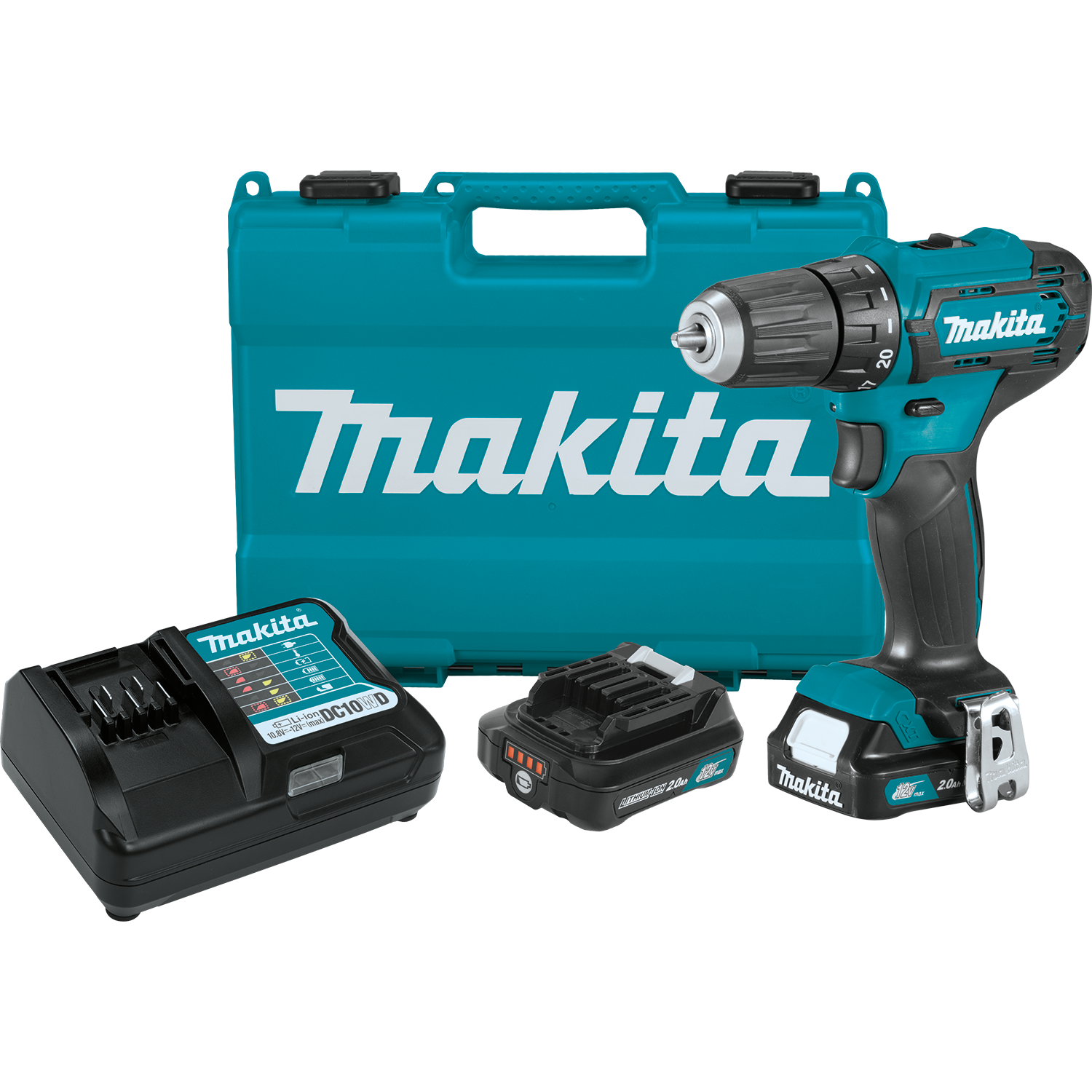
The exact FD09R1 page lists two BL1021B 2.0Ah CXT batteries, one DC10WD charger and one tool case. The manual separately lists approved battery and charger models; verify labels on the exact package.
Explore this need in the finder →Does the FD09R1 support hammer drilling?
No hammer-drilling mode is documented in the linked FD09/FD10 manual. The tool is described for rotation drilling and screwdriving, so it does not satisfy an essential hammer-mode requirement.
Explore this need in the finder →Can the FD09R1 accept a 1/2-in bit shank?
No. FD09R1 has a 3/8-in chuck (0.375 in), below the 0.5-in finder threshold. This is bit-shank capacity, not a hole-size limit.
Explore this need in the finder →Does the FD09R1 meet the 6-in tool-head condition?
Makita publishes a 7-in overall length, but no tool-head measurement. Overall length does not establish the finder’s 6-in head-length condition.
Explore this need in the finder →The Makita FD09R1 is a CXT 12V max kit around the FD09Z 3/8-in driver-drill. Its exact U.S. product page lists two BL1021B 2.0Ah batteries, a DC10WD charger and a tool case. That is a more specific package statement than the 2027 reference catalog's general “kit” label, and it distinguishes FD09R1 from the tool-only FD09Z and from the FD09 drill bundled inside the CT232 combo. Confirm the suffix and the written box contents before buying; a listing for a related CXT tool does not inherit this kit's batteries or case.
What this drill is—and is not
The FD09 is a conventional, brushed driver-drill, not a hammer drill and not an impact driver. Makita's linked FD09/FD10 manual describes drilling and screwdriving, two speed ranges, and a 21-position clutch. The exact FD09R1 page and its flyer state 0–450 rpm in low and 0–1,700 rpm in high, along with 250 in-lb maximum torque. These are manufacturer figures, not independently measured output or a promise that a particular fastener will seat in every material. When driving screws, the manual's clutch guidance and a trial on matching material are more useful than treating the torque figure as a setting recommendation.
The key interface distinction is its 3/8-in keyless chuck. That number is the maximum bit shank the chuck can hold, not a general hole-size rating. The manual separately lists capacity of 3/8 in in steel and 13/16 in in wood, and specifies limits for machine and wood screws. Those are maker-published capacities, not guaranteed results across every bit, material, workpiece or setup. The instructions call for suitable bits, a secure workpiece and controlled pressure; a binding bit can react suddenly. Wear eye protection and use the operating instructions for the material and accessory at hand.
Package and platform are part of the decision
The R1 suffix gets two 2.0Ah BL1021B packs and the DC10WD charger in the stated package, as well as the tool case. The FD09 manual lists BL1016, BL1021B and BL1041B batteries, and DC10SB, DC10WD and DC18RE chargers as applicable choices; use those exact instructions rather than assuming every battery or charger bearing a CXT label is interchangeable. Two included 2.0Ah packs describe the box contents, not a runtime estimate. Makita's page lists 2.4 lb with a battery; the manual's battery-dependent range is 2.4–2.7 lb. Neither source gives a bare-tool weight.
For a package comparison, FD09R1 contains the 3/8-in-chuck FD09Z drill, while FD10R1 packages an FD10Z hex-interface screwdriver/drill with two 2.0Ah packs, charger and case. They share the FD09/FD10 manual and broadly similar speed, capacity and torque figures, but their bit interfaces are not interchangeable assumptions: one has a conventional chuck, the other a 1/4-in hex interface. The current CT232 combo also uses the FD09Z machine, but pairs it with a DT03Z impact driver and uses two 1.5Ah batteries plus a bag. It is a distinct package, not an upgrade in drilling mode.
Clearance and suitability limits
Makita gives the FD09 a 7-in overall length. That measurement is for the complete tool, not the tool-head length used by the short-head finder condition. It cannot establish access in a recess, and it excludes the bit, hand position and approach angle from any clearance question. The exact page's weight likewise includes a battery. The sources do not settle tool-head length, tool-only weight or whether a particular bit/material combination is right for your job. Treat those as unresolved rather than deriving them from a product photograph.
FD09R1 makes sense to compare when you want a small CXT drill/driver with a standard chuck and the exact kit page's two named 2.0Ah batteries, charger and case. It is a poor match if you need documented hammer action, a 1/2-in chuck, a proven tool-head measurement, or a different battery platform. Its short overall body and compact-platform label do not answer those separate requirements. Check the exact package suffix and manual's battery, charger, bit and material limits before deciding.
Key specifications
Key details at a glance
| Brushless motor | No |
|---|---|
| Maximum chuck capacity | 0.38 in |
| Maximum no-load speed | 1700 rpm |
| Screwdriving clutch settings | 21 |
| Battery platform | Makita 12V max CXT |
| Exact package type | Battery included kit |
| Included battery model | BL1021B |
| Capacity per included battery | 2 Ah |
| Included charger model | DC10WD |
| Kit bag listed | No |
| Hammer-drilling mode | No |
| Documented operating modes | drilling / screwdriving |
| Battery included in this SKU | Yes |
| Charger included in this SKU | Yes |
| Included accessory | two BL1021B 2.0Ah batteries / DC10WD charger / tool case |
Use the exact model’s instructions for operating limits, supplied equipment and version differences.
Sources for this review
Sources for this assessment

Compare your requirements before choosing
Use the finder to keep the essential job, battery system and exact package separate. The match is a research filter, not proof of fit or a live retailer offer.